
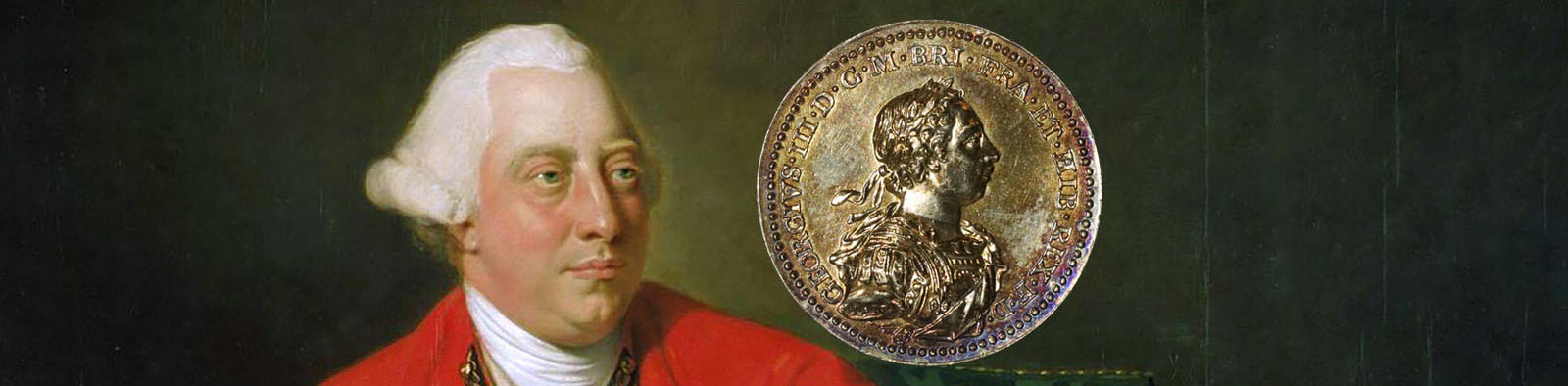
George III
Summary
The reign of George III saw great loss and great gains in terms of coinage. While gold coins were struck regularly, first as guineas and finally with the introduction of the modern sovereign in 1817, silver and copper coins were comparatively rarer. The absence of silver coinage in the early part of the reign eventually led to the Bank of England issuing countermarked Spanish silver coins to meet demand. The few copper coins struck for small change led to an influx of unofficial token coinages created by private business owners, and ultimately to Matthew Boulton being awarded a contract to strike what would become known as the Cartwheel Penny. This reign showcased the work of some of the Mint’s best known engravers, such as Lewis Pingo, Thomas Wyon, and Benedetto Pistrucci – not surprising, given that George III has perhaps more different coinage portraits than any other British monarch.
The Mint
Owing to the poor state of the coinage, a Committee of the Privy Council on Coin was set up in 1798 to investigate coinage reform. The Committee included the Earl of Liverpool and Sir Jospeh Banks, notable botanist and coin collector. John Rennie, an engineer, was tasked with investigating the running of the Mint, which he found to be grossly inefficient. He recommended that a new building be constructed and that up-to-date machinery be installed. Construction began in 1804 on a new Mint at Tower Hill, just opposite the current location in the Tower of London. It was built on the old site of the Abbey of St Mary of Grace, commonly referred to as East Minister, which had been destroyed during the dissolution of the monasteries. It was replaced by a naval victualling yard before being used as a tobacco warehouse. The new building was designed by James Johnson and completed by Robert Smirke, costing nearly £300,000 to build and equip.
The Committee of the Privy Council on Coin were so impressed with the work undertaken at Matthew Boulton’s private mint in Birmingham that the contract to supply new presses fell to Boulton. The equipment was set up under the supervision of the engineer John Rennie and staff were employed from Birmingham at great expense to help maintain it. By February 1810 the first machinery had been installed but the full move out of the Tower was slow, the keys finally being surrendered in 1812 when space was urgently required to house injured troops returning from India.
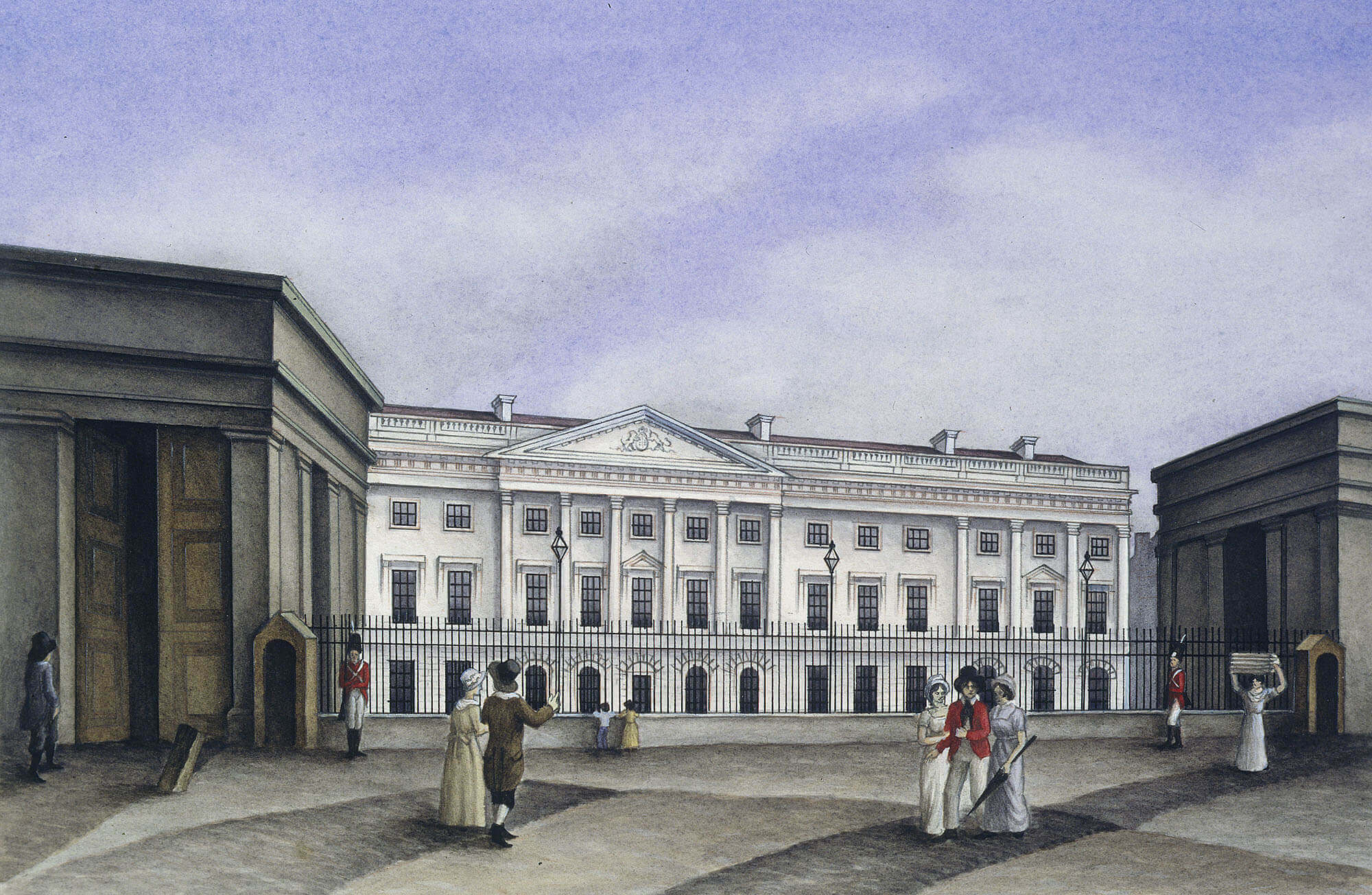
The front facade of the Royal Mint building at Tower Hill circa. 1810
The equipment was thoroughly modern in comparison to that left behind in the Tower and four new rotative steam engines were acquired to run it. One of 30-horse power, drove three grades of rolling mills which helped reduce and finish the ingots of metal to the correct thickness for blanking. Twelve presses for cutting the blanks were arranged in a circle beneath a large horizontal wheel, which spun at a rate of 64 times a minute. This drove punches down in rapid succession, cutting the blanks as the fillets of metal were pulled through by hand. Eight coining presses were driven by a 10 horse-power engine and incorporated an automatic device to place the blank accurately on the lower die before pushing it away after it was struck. A collar rose to hold the blank during striking, before sinking free to release the finished coin, and these new presses were capable of striking coins at around 60 pieces a minute - a marked improvement on the old manual screw presses used in the Tower. Even so, some of these were retained, two being brought over from the Tower to add to the purchase of a new screw press. These made all the punches, dies and medals which required repeated blows of a controlled strength to make them correctly.
Coinage reform
The Earl of Liverpool had recommended that gold should be the standard coin of full weight, but that silver and copper coin should be token coinages with intrinsic values below their current value and should be redeemable in gold on demand. To this end, the 1816 Coinage Act was passed through Parliament.
Gold coinage
Whilst patterns exist, no five-guinea or two-guinea pieces were issued during George III’s reign. Guineas and half guineas were, however, regularly struck for nearly every year between 1761 and 1799. The practice of removing gold by filing down or rubbing gold from guineas continued to be an issue. An Act of Parliament passed in 1774 placed legal lower weight limits on guineas. This resulted in additional work for the Royal Mint owing to the number of light weight gold coins which were returned to be melted down and restruck.
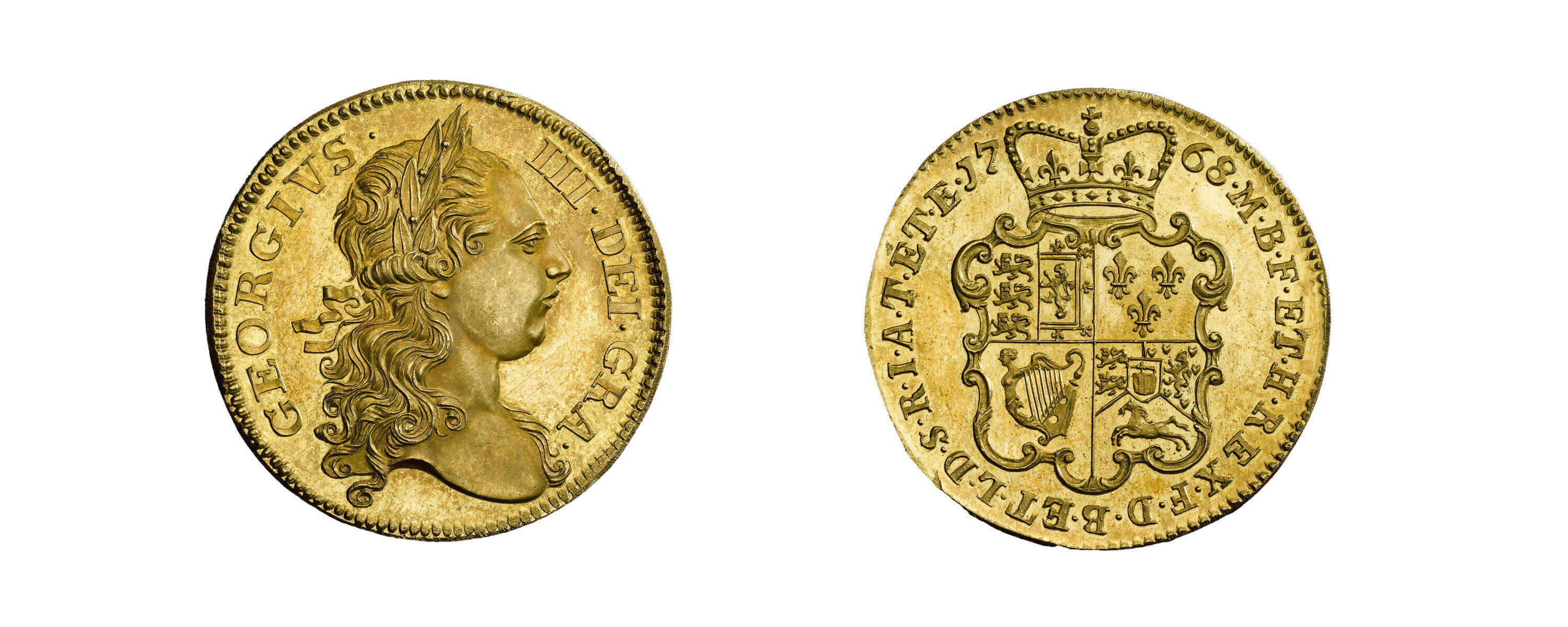
George III two guinea piece (RMM938)
Up until 1787, an elaborate shield appeared on the early guineas of George III. These were sometimes referred to as ‘rose’ guineas, but the rational for the name is unclear as the design has little resemblance to a rose. This was replaced with a plain, flat-topped shield which, owing to its similarity to the old-fashioned spade, led to the coins being called ‘spade’ guineas. After the coins were called-in during the 19th century, guineas of this design were fondly remembered by the public and obtained a degree of popularity often being used as watch chain pendants and being reproduced as tokens or toy coins.
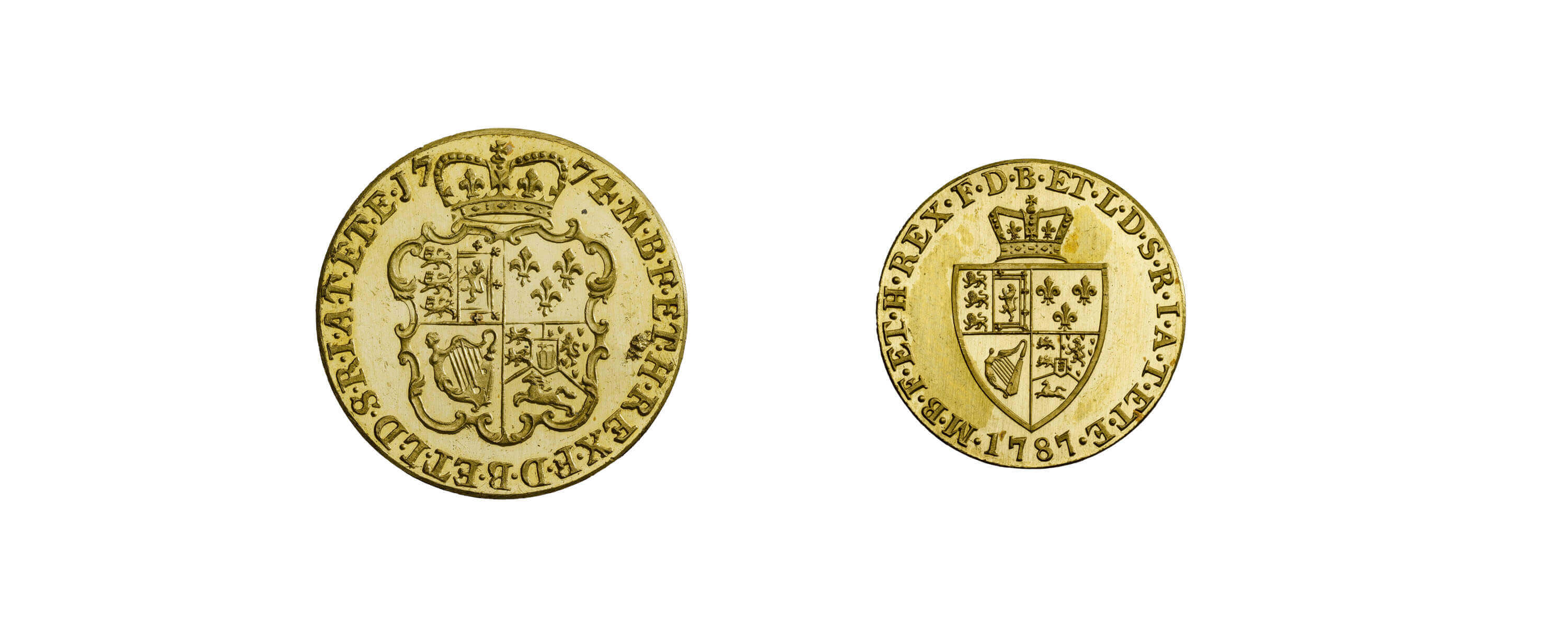
George III guinea (RMM943)
The striking of gold was halted in 1799. The hazards of the war with France made it too difficult to import gold from overseas and it is possible that the 1798 and 1799 guinea were actually held in the Bank of England until as late as 1813.
Quarter-guineas were issued in 1762 but were never popular and were not minted in later years. To supplement the supply of half-guineas, and to make up for the shortage of silver coins, a new denomination of seven shillings, or a third of a guinea, was introduced in 1797.
A guinea, the first to be struck in over a decade, was issued in 1813 which became known as the ‘military guinea’ as many were used to pay Wellington’s army in the Peninsular. Only about 360,000 were produced, it being the first and only guinea to be struck at the Mint’s new premises at Tower Hill, the modern 20 shilling sovereign being introduced to replace the awkward 21-shilling guinea in 1817.
The sovereign was the work of Italian engraver Benedetto Pistrucci, who had designed both the obverse and reverse. The reverse, featuring its distinctive St George and the dragon design, has since gone on to be considered one of the artistic triumphs of the modern coinage but had a mixed reception when it was introduced. Sovereigns were struck annually from 1817 up until the end of the reign in 1820. Those of 1819 are incredibly rare owing to an aborted plan by economist David Ricardo to replace the coin.
It had always been the intention to issue specimens of the new five-sovereign piece and double sovereign but George III died in January 1820 before the dies were completed. They were, however, already at an advanced stage and, rather than waste the work, it was decided that a few proofs should be issued. Accordingly in December 1821, the Mint was able to offer proof specimens of the two coins to a select group of institutions and people. It is the portrait for the five-sovereign piece which has been used for the British Monarch collection.
Silver coinage
The most significant feature of the silver coinage of George III is its absence, minting of silver reaching a virtual halt by the end of the eighteenth century. There was no incentive to turn silver bullion into coin as the price paid for silver by the Mint was lower than its openly traded bullion value. The larger coins, crowns and half crowns, were often hoarded because of their size, a factor which also made them convenient for export and melting down. The circulating currency consisted primarily of shillings and sixpences, many of which were old and worn down to nothing but blank discs. A small number of threepences were struck and issued between 1762-3, along with a number of shillings dated 1763. These last pieces are often referred to as ‘Northumberland shillings’ as some were thrown into the crowd when the Earl of Northumberland rode in procession through Dublin to be sworn in as Lord Lieutenant of Ireland.
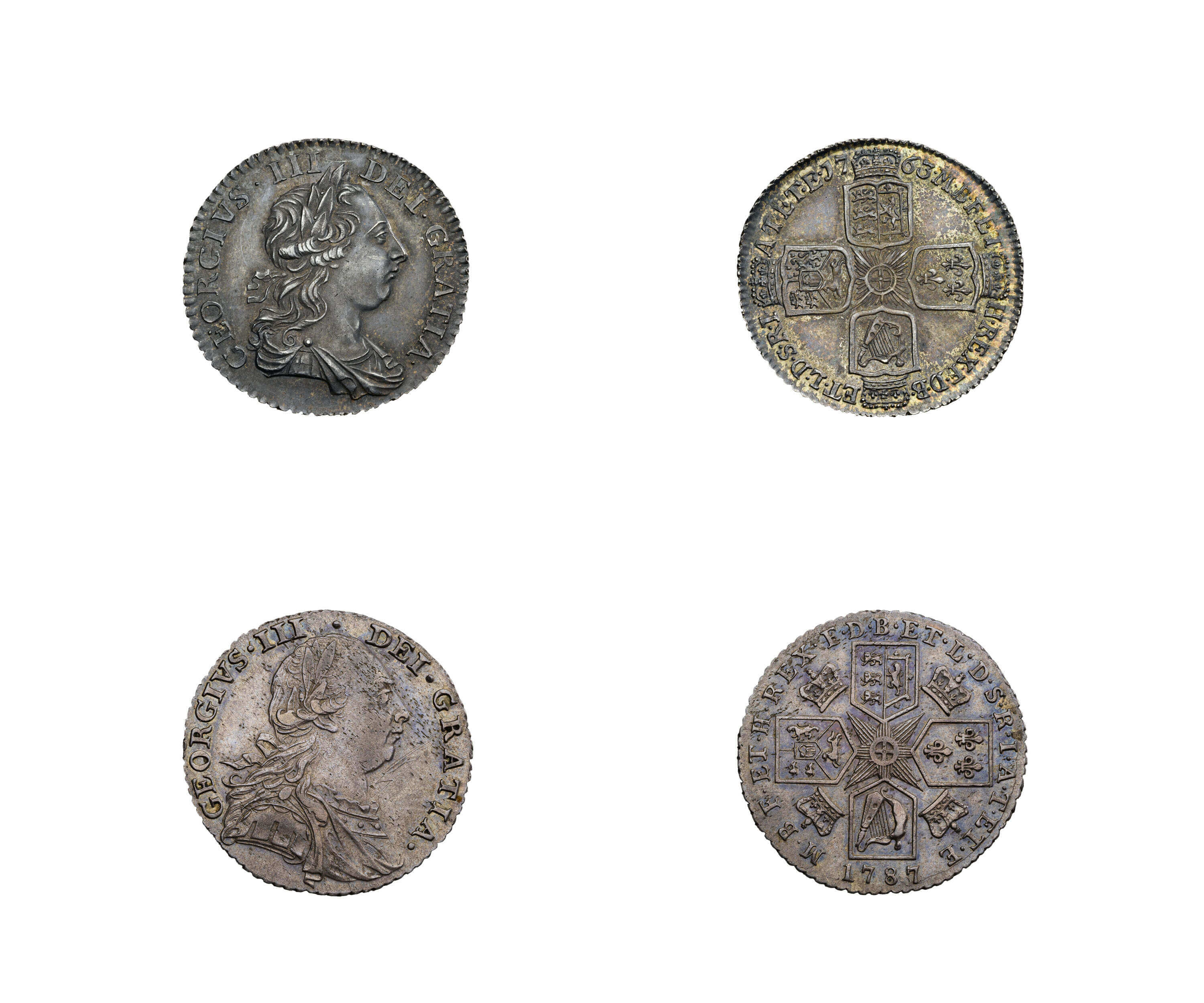
George III shillings (RMM978, RMM982)
Apart from Maundy coins, no other silver was struck until the year 1787 when the Bank of England had produced at a loss a quantity of shillings and sixpences. Not intended for general issue, these pieces were kept by the Bank to oblige customers who wanted new silver coins at Christmas. Many of the coins remained in the Bank’s vaults for a number of years and their lack of active circulation is reflected in the good condition of the surviving pieces. In 1798 there was a temporary fall in the price in silver and, led by the banking firm Dorrien and Magens, several banks sent silver to the Mint to be turned into shillings. As coinage reform was being actively discussed, an Order in Council forbade the issue and instructed them to be melted down making the Dorrien and Magens shillings a rarity.
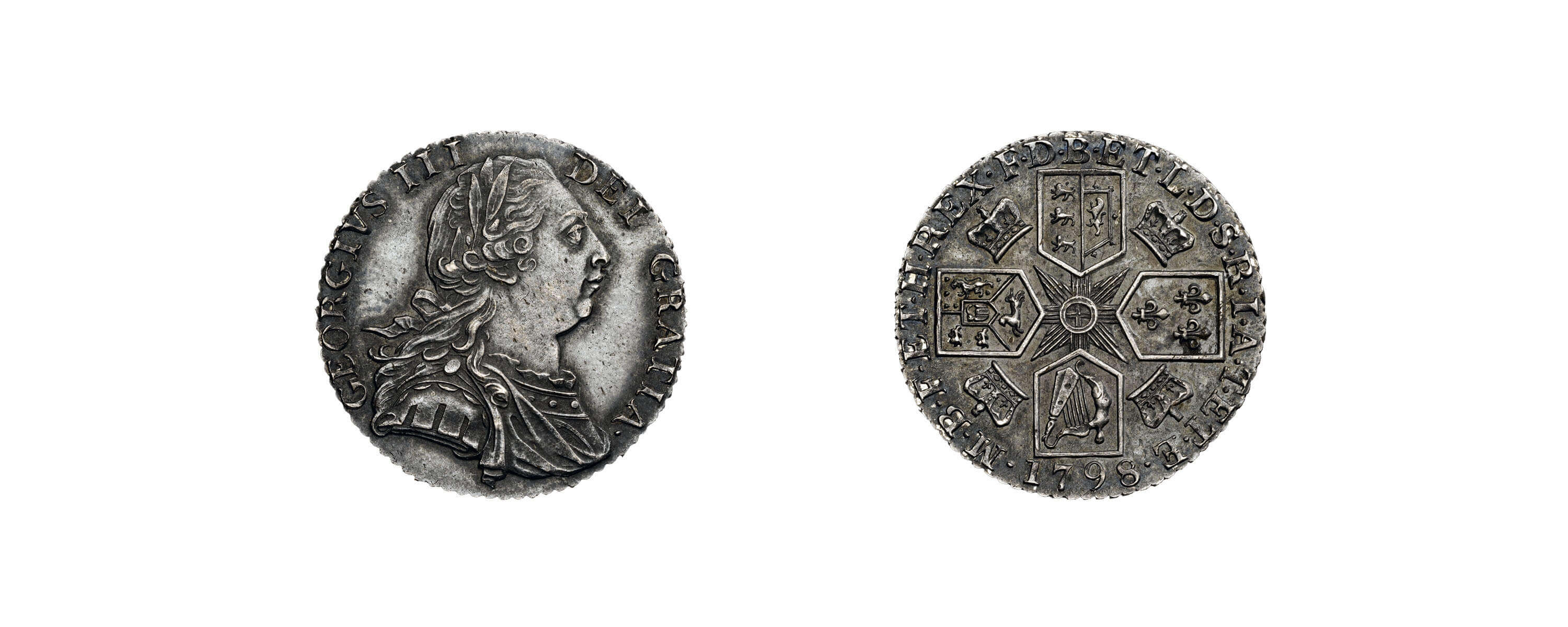
George III shilling (RMM1020)
The shortage of silver by 1797 had become so acute that the Bank of England began purchasing Spanish silver 8 reals or dollars. These were countermarked with a small oval punch bearing the head of George III, which was normally used by Goldsmiths’ Hall for hallmarking silver plate. The dollars were slightly lighter than the English crown, and of a lower fineness, and they were reissued to the public in the spring of 1797 at a value of 4s. 9d. This value gave rise to the popular expression ‘two King’s heads not worth a crown’ as they were valued at less than the 5-shilling crown piece. They were extensively counterfeited, and sometimes genuine dollars were given false countermarks. To address this, the Bank began calling in the dollars and they were declared no longer legal tender from the end of October 1797.
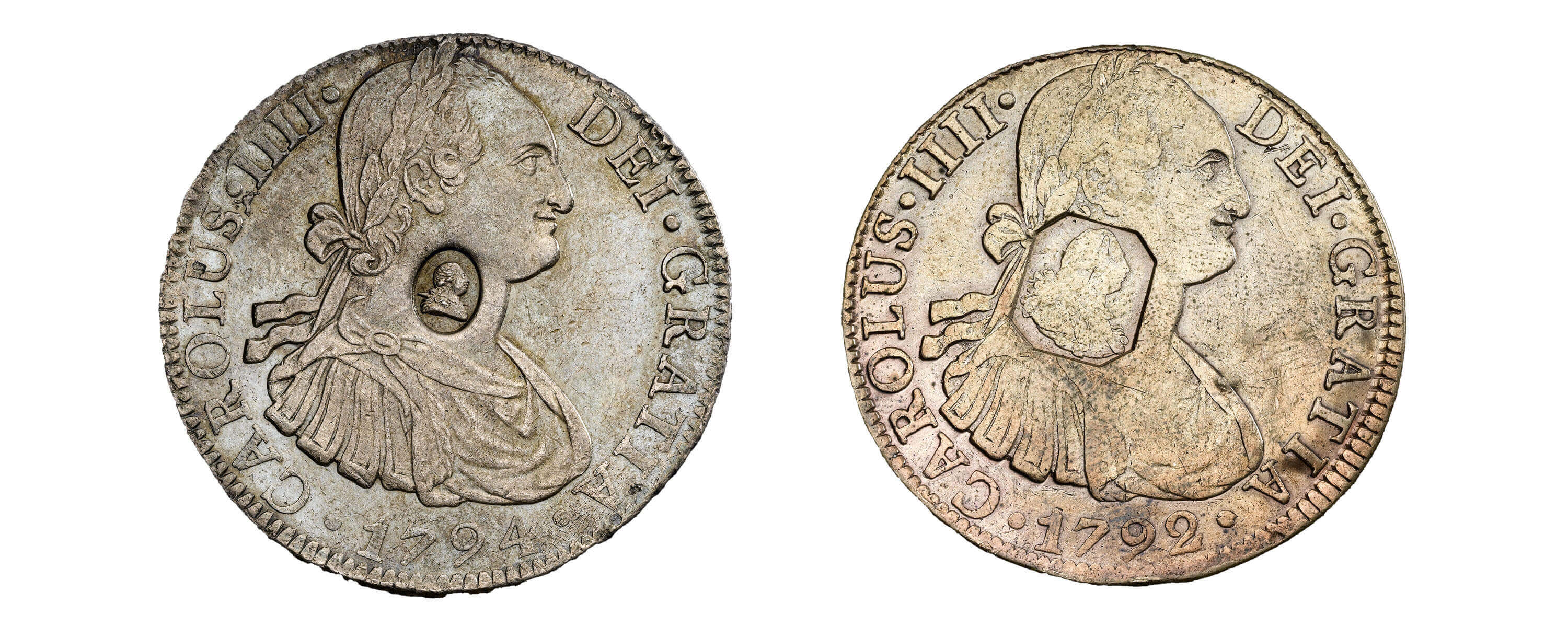
George III one dollar coin (RMM1135) and one dollar electrotype (RMM1137)
The countermarking of Spanish silver resumed at the Mint in 1804 but, instead of the oval stamp previously used, a new octagonal stamp was applied, the punch of the Maundy money being applied for the portrait of George III. These were once again heavily counterfeited, and it fell to Matthew Boulton’s private mint to overstrike the Spanish coins with a new design using steam powered presses. These Bank of England dollars, as they were called, feature a portrait of the King by Birmingham mint engraver Conrad Küchler and the figure of Britannia on the reverse. The striking continued for some years but nearly all bare the date 1804, regardless of when they were made.
In addition to the official supply of countermarked Spanish coins, a large number of companies took matters into their own hands and began counter stamping Spanish coins, or creating their own silver tokens, as a way to make up for the lack of official silver coins. To help prevent this, the Bank of England issued a series of official Bank tokens. Made by the Royal Mint at its recently opened premises on Tower Hill, they were struck from melted down Spanish silver into three-shilling and 1s. 6d. pieces between 1811 and 1816.
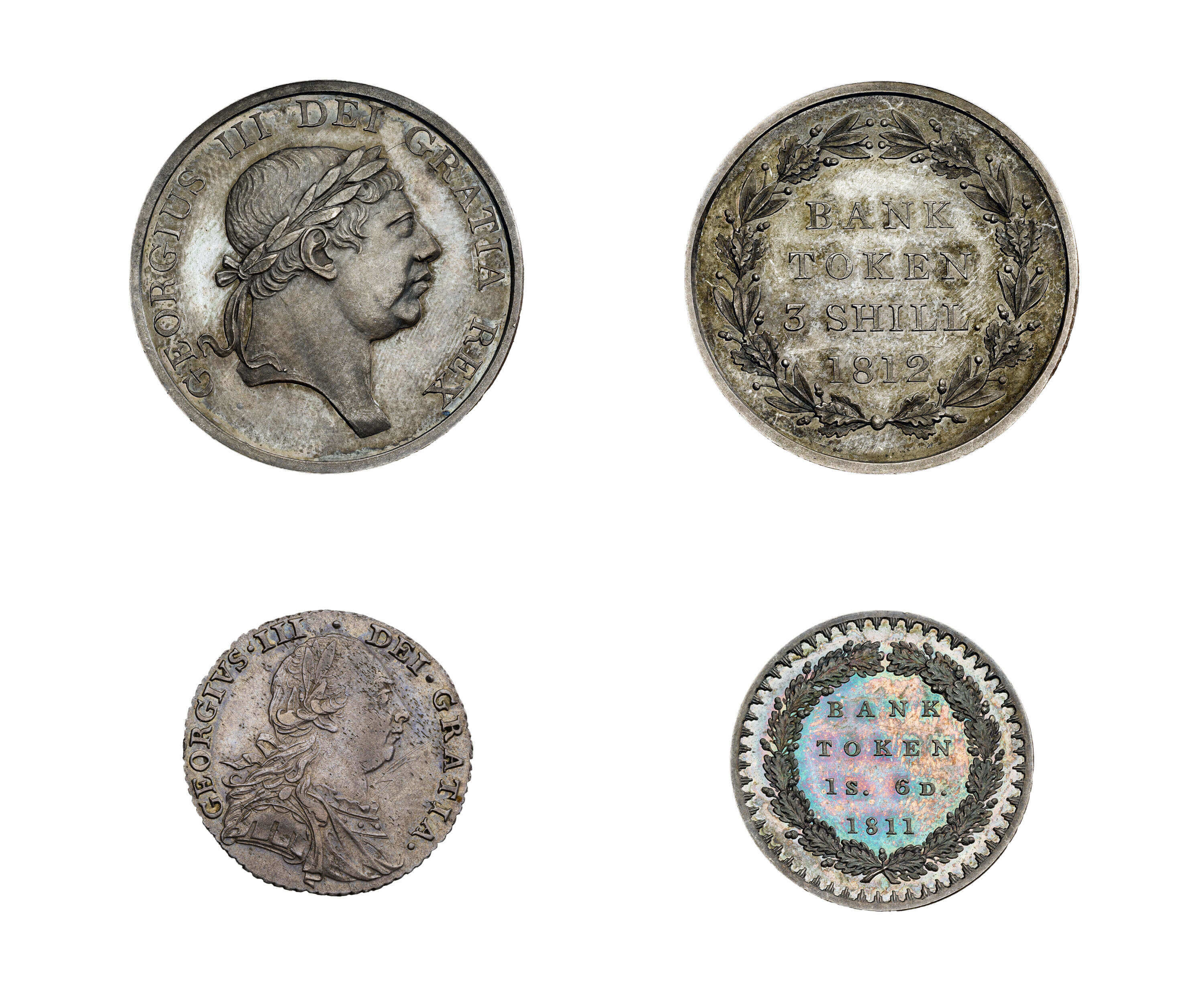
Bank of England three shilling token (RMM1146) and eighteen pence token (RMM1150)
As a result of the neglect of the silver coinage throughout the latter half of 18th century, the coinage was awash with counterfeits and badly worn coins. The coinage reforms of 1816-17 presented an opportunity to correct the situation and a recoinage of millions of silver pieces began at the Mint’s new Tower Hill site. Using Matthew Boulton supplied steam presses, a new silver coinage of a slightly reduced weight and size was produced. This was executed with a thoroughness and efficiency that was so characteristic to the Master of the Mint, William Wellesley Pole, and the new silver coins were exchanged for the dilapidated, worn pieces from February 1817.
Copper coinage
No copper coins were struck during the first 10 years of George III’s reign and this resulted in a number of counterfeit George II halfpennies and farthings being created to fill the void by the lack of official pieces. To avoid counterfeiting legislation, many of these limitations did not copy the exact inscription of the original coins resulting in often very peculiar legends. During the period 1770-5 copper halfpennies and farthings were issued to the same weight and style as the copper pieces of George II. They feature a laureate and cuirassed bust of the king on the obverse and reverse design of Britannia holding a spear and olive branch. Right from the start of the issue, the new coins were steadily melted down to make light-weight counterfeits. The Monthly Review of September 1771 complained that ‘though there had been a new coinage and twenty tons is already delivered to the public, and yet we see but few of them, owing to their being destroyed by makers of counterfeit halfpence’. After 1775 there was a gap of 22 years during which time no regnal copper coins were struck.
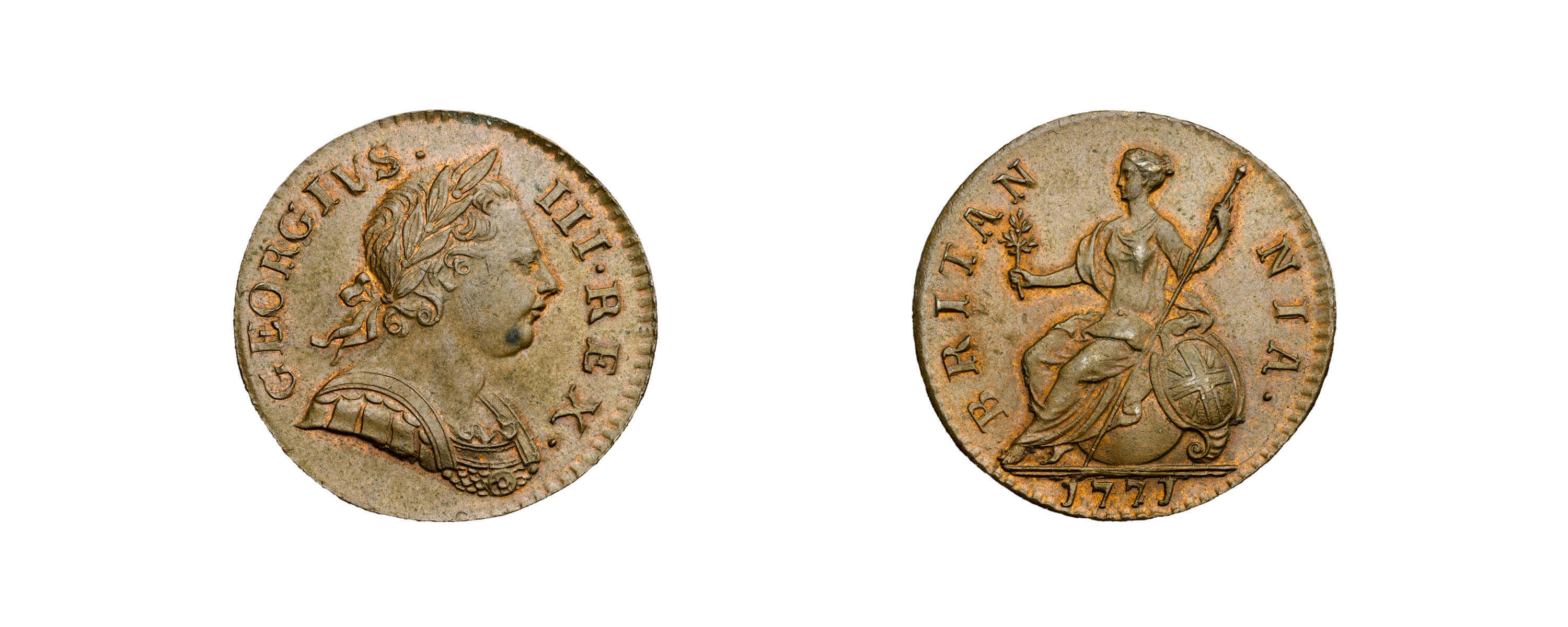
George III halfpenny (RMM1071)
The shortage of small change in the late 18th century led to a flood of new token coins being produced to fill the gap. Many companies resorted to issuing tokens as a way to pay their labour force. Most featured the name of the issuer as a supposed guarantee of good faith, and some were even produced as political propaganda. Notable issues include the Parys Mining Company of Anglesey which were struck from copper obtained from their own mines. These tokens depicted a druid’s head on the obverse and the cypher of the company on the reverse.
The entrepreneur Matthew Boulton established his own mint near Birmingham in the 1780s using the latest technology. In 1788 he installed the first steam driven coinage presses which, by the end of that decade, could produce 50 large or 150 small coins a minute. Boulton produced a variety of pattern halfpennies and farthings using this new equipment but was unable to convince government to take an interest until 1797 when he was eventually given the contract to strike copper pennies and twopenny pieces. These coins are remarkable for their size and workmanship, the quality of which made forgeries near impossible. Being so large and having a distinctive rim, the coins picked up the popular name, ‘cartwheels’. The reverse features the image of Britannia, the design helping to emphasis Britain’s increasing maritime power by introducing a trident, adding in the waves and a man of war. Following the introduction of the twopence and penny pieces, Boulton began producing halfpennies and farthings of a similar design but without the rim from 1799.
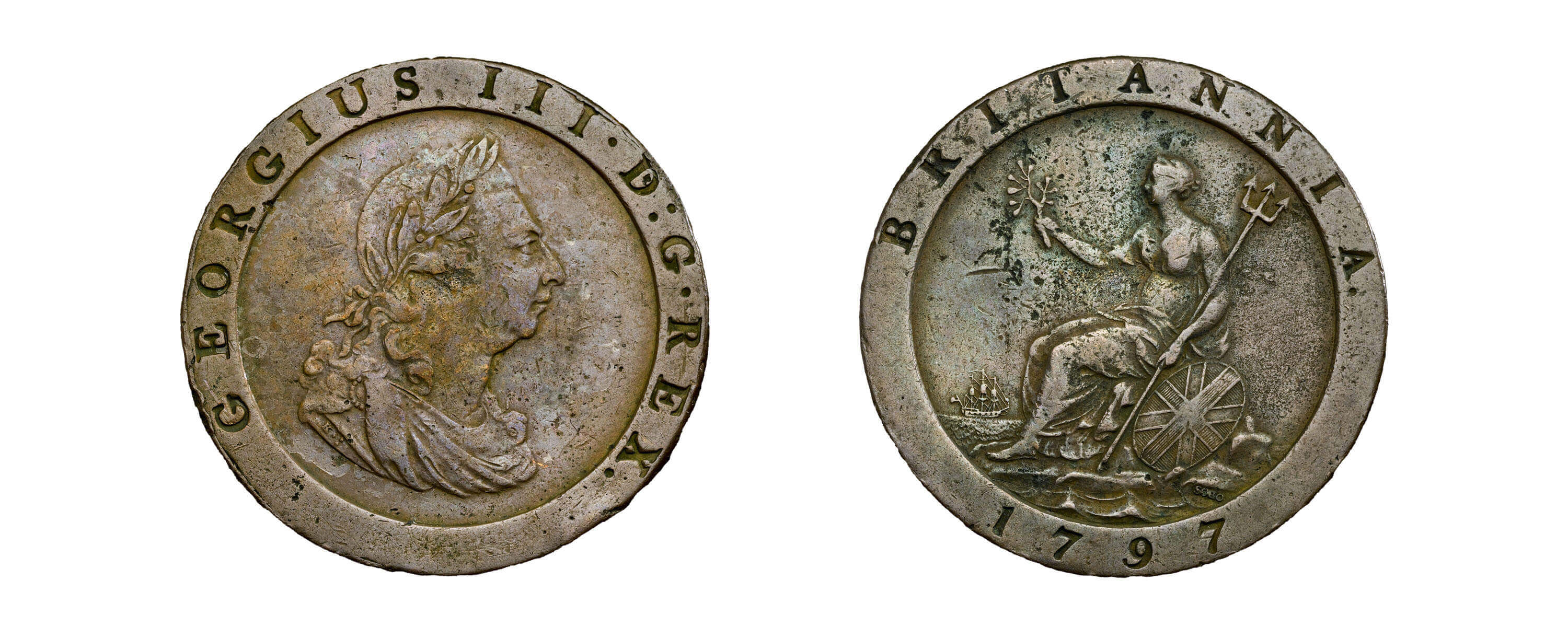
George III penny (RMM1089)

Legend
In negotiations with France in 1801, the British monarch’s claim to the French throne was dropped. This resulted in changes to the royal arms and the royal style and titles.
On the gold coinage the obverse broadly carries the inscription GEORGIVS ∙ III ∙ DEI ∙ GRATIA ∙, although some minor changes occur in the placement of the stops. For the reverse the legend M ∙ B ∙ F ∙ ET ∙ H ∙ REX ∙ F ∙ D ∙ B ∙ ET ∙ L ∙ D ∙ S ∙ R ∙ I ∙ A ∙ T ∙ ET ∙ E ∙ is used (KING OF GREAT BRITAIN, FRANCE AND IRELAND, DEFENDER OF THE FAITH, DUKE OF BRUNSWICK AND LUENENBURG, ARCH TREASURER AND ELECTOR OF THE HOLY ROMAN EMPIRE). When the King’s styles and titles changed in 1801, the legend was simplified on the guineas of 1813 to BRITANNIARUM REX FIDEI DEFENSOR (KING OF THE BRITISH TERRITORIES, DEFENDER OF THE FAITH).
Portrait
There are quite probably more changes of portrait for George III than in any other reign and it would be impossible to list all the variants succinctly. Some of note include the portraits prepared by Benedetto Pistrucci for new coinage issued from 1816 until the end of the reign. The head on the half-crown is a robust portrait of the monarch shown from the back, depicting his shoulders and a thick, bulbous neck. Owing to this, the portrait has since become known as the ‘bull’s head’ and the design was not popular with the public at the time. Pistrucci blamed much of the popular reception of his designs for the silver coinage on Thomas Wyon junior. He was responsible for translating Pistrucci’s portraits of George III into steel, a job which Pistrucci felt was done badly. To avoid a repetition of this, Pistrucci taught himself to engrave into steel.
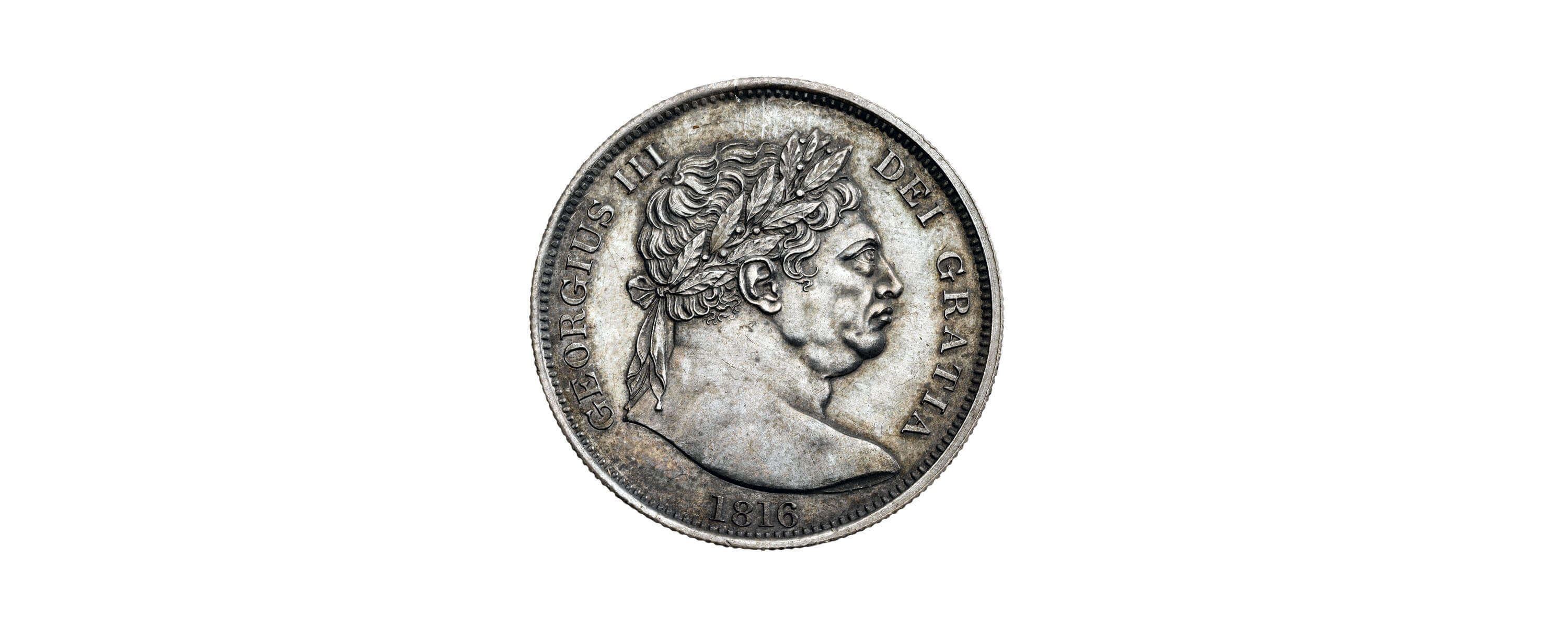
George III half-crown (RMM1200)
Prior to the reform of the coinage after the Battle of Waterloo, early gold coins with a youthful bust were designed by Richard Yeo. Normally the prerogative of the Chief Engraver, the work fell to Yeo as Assistant owing to John Tanner’s poor eyesight. His portrait reveals an engraver of considerable talent and is therefore surprising that he was not offered the opportunity to produce another portrait when one was required in 1770s. These later coins, designed by Thomas and Lewis Pingo, feature a more mature portrait of the monarch.
Engravers
John Sigismund Tanner, who had been appointed to the Mint in 1729 and later promoted to Chief Engraver in 1741, was still in post at the start of the reign. By 1768 Tanner’s eyesight was failing and, on account of his long service with the Royal Mint, he was granted a yearly pension of £200 for the rest of his life. Having previously lived in the Tower of London in the Chief Engraver’s residence, Tanner moved out and lived in retirement until his death in March 1775.
Even though Tanner was in post at the start of George III’ reign it was Richard Yeo who was effectively acting as Chief Engraver, a position to which he was formally appointed when Tanner retired in 1768. Little is known of Yeo’s early life, but he seems to have been an established medallist by the time he was appointed as the Mint’s Assistant Engraver in 1749. Excluding pattern pieces, his original work on the British coinage is limited and it is chiefly as a medallist that he is remembered today. He was a founding member of the Royal Academy and contributed to its first ever exhibition in 1769. A year later he would go on to exhibit a proof five guinea piece. He died in office in 1779 in his late fifties.
After Tanner’s death, Lewis Pingo replaced him as Chief Engraver. He was the son of Thomas Pingo, who had acted as Assistant Engraver from 1771 until his death in 1776. Lewis stepped into his father’s vacant role as Assistant, but he was already a medallist of some skill before coming to the Mint. During his time at the Mint, he produced a number of coinage designs for gold and silver which include the fondly remembered design for the spade guinea.
John Ralph Ocks was another engraver of the period, having been appointed by Royal Warrant of 1 December 1757 as Third Engraver on a salary of £80. Following the promotion of Yeo to Chief Engraver, Ocks was moved up to the post of Second Engraver, a position that he held until he was pensioned off in 1787 after being granted a pension of £126. 6. 0 a year. Some years earlier he had declined the post of Chief Engraver after the death of Yeo in 1779, believing himself too old for the position. He died in 1788 at the age of 84 in Battersea.
Nathaniel Marchant served as an Assistant Engraver from 1797, holding the office until his retirement in 1815. Born in Sussex in 1739 he earned a reputation as a gifted a gem engraver working in Rome between 1773 and 1789. He became a member of the Royal Academy in 1809 and, despite holding office with the Mint for a number of years, his only meaningful contribution to the coinage was the portrait head of George III for the ‘military’ guinea, although this might be explained by his lack of enthusiasm for the post. A letter of 29 January 1798 complained that Marchant had shown neither ability nor inclination to serve the Mint, whilst another of 1801 claimed that he was ‘so tedious that it is really in vain to wait to see him’. Marchant died in Somerset Place, London on 16 April aged 77.
For the new coinage from 1816, the portraits are by the of Italian gem-engraver Benedetto Pistrucci who began work with the Royal Mint after coming to the notice of the Master of the Mint William Wellesley Pole. His St George and the dragon design, which appeared on the modern sovereign in 1817, has since gone on to be considered a classic, and still graces the reverse of the sovereign over two centuries later.
Thomas Wyon junior had been appointed to the Engraving Department in 1811 as a ‘young artist of promising abilities’ before becoming Chief Engraver in 1815 whilst still in his early 20s. He was assisted for a while by his father, Thomas senior, but it was his younger cousin, William Wyon, who was appointed as Second Engraver in 1816. Sadly, the two Wyons were not destined to work together for long. Thomas Wyon junior died in September 1817 leaving the post of Chief Engraver vacant.